The Bible
Skip to: Translations · Understanding the Bible · Getting a Bible
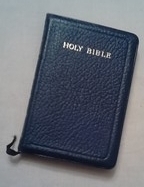
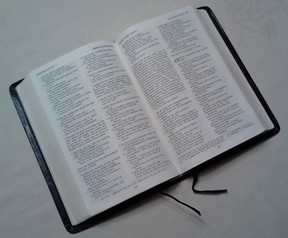
The Bible is a book — or more accurately a collection of books bound together — that contains what Christians understand to be the Word of God. The Bible (also known as the Scripture) is divided into the Old Testament (39 books, all written many years before Christ lived) and the New Testament (27 books, written between about 35 AD and the end of the first century AD). It is thought to be the most printed, sold and read book in human history. The complete Bible has been translated into over 500 languages, and parts of it into over 2,500 languages, including over 50 sign languages.
Its Content
It includes ancient stories, historical accounts, legal discussion, words of praise, poetry, wisdom, prophecy, records of visions, four accounts of the life and teaching of Jesus (including his famous parables, his death and resurrection), details of how the early Church developed, and letters from some of the early saints (mainly St Paul).
It has given us some familiar phrases: we speak of someone having “feet of clay”, being “a good Samaritan” or a “prodigal son”; we talk of a “thorn in the flesh”, “an eye for an eye” and a “wolf in sheep's clothing”; and many will ask, “Am I my brother's keeper?” or announce that “no one can serve two masters”, or wisely base their marriage on “not letting the sun go down on your anger” — without realising that all of these phrases come from Scripture.
A Few Favourite Passages
Everyone has their favourite Bible verse or passage — here are a few that many find speak deeply.
The Bible is not just for use in services — many Christians find it very helpful to read the Bible each day, maybe following a pattern of readings or using daily Bible reading notes (see Helps & Notes below). Others enjoy being part of a Bible study group, reading and sharing its insights together (see our Explorers Bible Study group).
Translations
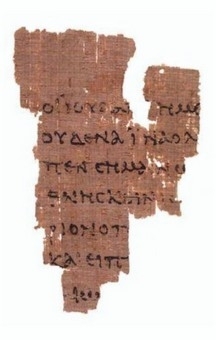
In common with all ancient texts (Aristotle or Tacitus, for instance) no original manuscripts survive; however there are a surprising number of copies made in ancient times which, for the most part, have very few significant variations. The oldest known fragment of a New Testament text is a piece of a copy of John's Gospel, dated c.125 AD — quite possibly less than thirty years after the original was written — which includes Pilate's question of Jesus, “What is truth?”

The Bible was not originally written in English. The Old Testament was written in ancient Hebrew and the New Testament in ancient Greek — both quite different from their modern derivatives. Soon after the exact contents of the Bible were agreed in the fourth century, a translation was made into Latin (the Vulgate, meaning ‘in the common tongue’), and this version served the European Church for over 1,000 years.
The first English translations were made during the fifteenth century and, following the English Reformation in 1537, it became compulsory to read the Bible in English in our churches. A major new translation was authorised by King James in 1611 and, with printing now well established, became widely distributed — this ‘Authorised’ or ‘King James’ Bible was used in churches and homes almost exclusively for the next 300 years or more.


Huge advances have taken place in biblical scholarship since, including the discovery of better ancient manuscripts and a greater understanding of the biblical languages. The finding of the Dead Sea Scrolls at Qumran in Israel in 1946–56 was one of the most notable contributions, and continues to extend our understanding.

Following the Second World War a large number of new English translations have been produced, each with its own merits and drawbacks. Some concentrate on exactness, others on readability or suitability for reading aloud; some reflect the concerns of a particular denomination, others seek to be more universally acceptable. There are also now versions of the Bible for specific groups — children, teenagers, students and so on.
Here is one small example of how different translations reflect a passage. Isaiah 40 verse 3 foretells the coming of God's messenger. The Authorised King James translation reads: “The voice of him that crieth in the wilderness, Prepare ye the way of the Lord, make straight in the desert a highway for our God” — which we can understand, but is clearly different from modern English. Two modern translations give the same verse as: “A voice cries out: ‘In the wilderness prepare the way of the Lord, make straight in the desert a highway for our God’” (New Revised Standard Version), and “Someone is shouting: ‘Clear a path in the desert! Make a straight road for the Lord our God’” (Contemporary English Version).
It's always important to remember that, whichever translation we're using, the work of the translators will inevitably have allowed their own presuppositions and preferences to colour the thoughts of the original author. When choosing a version for daily reading and devotions, it's worth picking one you're comfortable with — and when in doubt about what a passage means, try looking at it in several different versions.
Understanding & Interpreting the Bible
Most Christians believe that God inspired the original authors of the biblical texts, through his Spirit, so that they wrote his words. However, in our very different culture and situation, and reading in a different language, we have to work out — again with the help of his Spirit and prayer — what God is saying through them to us. This process of interpretation is difficult and demanding, and will sometimes lead different people to different conclusions.
Some suggested techniques for interpreting the Bible: always pray when reading or trying to understand it, asking God's Holy Spirit to reveal his meaning; start by trying to understand what the original authors meant and what their original readers would have understood, bearing in mind what type of text you're reading (a historical narrative needs to be read differently to a poem or a parable); only then try to understand what it might mean today, allowing for the difference between their situation and ours; don't concentrate too hard on individual verses without paying attention to their context; always seek to read Scripture “in the round” — looking at all the Bible has to say on a topic rather than focusing on one passage; don't be afraid to seek help from published notes and commentaries, or from respected Christian friends or ministers; and be cautious of any interpretation that seems peculiar — the generally accepted, traditional understanding will often have great merit.
Helps & Notes
A number of organisations publish and distribute notes, devotionals and commentaries to help us understand and interpret our Bible — a selection is given on our Links page. If you have questions about the Bible or what it might mean, any of our clergy will be very happy to help (see our Contacts page).
Getting a Bible
In Britain we are very blessed: copies of the Bible can be found for sale in many high street bookshops, in specialist Christian shops (for instance The Olive Tree near Spilsby, or The Ice House in Grimsby), or from online retailers. They are also often available in hotel rooms courtesy of the Gideons, and there are a number of websites from which passages of Scripture may be downloaded — see our Links page. Or, if you prefer, just ask us (see our Contacts page) and we will give you one!
Gallery